What are the key takeaways?
•The short answer: Medford's most walkable neighborhoods for living without a car are the half-mile rings around the College Avenue and Ball Square Green Line stations. College Avenue is the cleaner Medford pick. Ball Square's entrances and main shops are on the Somerville side. Wellington on the Orange Line is the third option.
•The catch: Homes near the T may cost more. Compare similar listings inside and outside the half-mile ring before you offer.
•The decision rule: Buy inside the ring if the extra monthly cost is less than what you save by giving up a car.
•The bottom line: Daily rail commuters can realistically go car-free near these stations. Everywhere else, plan for car-light living.
Can you really live without a car in Medford?
Yes, near a few rapid-transit stations. Elsewhere, expect to live car-light, which means you keep a car or use one occasionally.
The Green Line now runs into Medford, which opened new options for first-time buyers. Focus on the half-mile walksheds around College Avenue and Ball Square. A walkshed is the area you can reasonably walk from a transit stop.
Why half a mile? Transit planners often treat it as a comfortable walk, and Massachusetts law uses it too. Under state regulation 760 CMR 72.02, a "developable station area" means developable land within 0.5 miles of a transit station.
The MBTA Communities Act also pushes cities to allow multi-family housing near transit "as of right," meaning a builder doesn't need a special permit. The minimum density is 15 units per acre, which means room for apartment and condo buildings, not just single-family homes.
More housing near stations usually brings more shops and services within walking distance. It also brings more competition, now and when you sell. If daily walkability is your main goal, the added amenities usually matter more.
Which stop gives you a true Medford address?
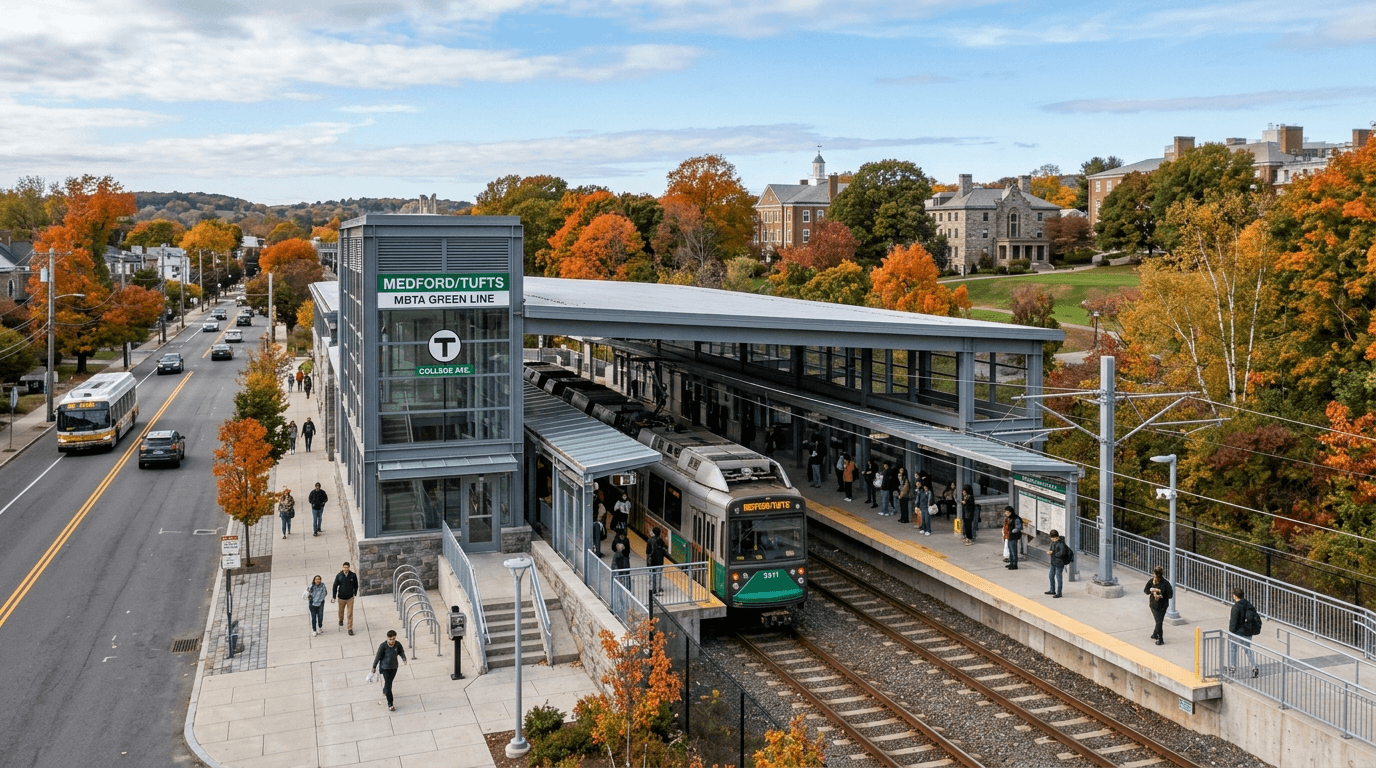
College Avenue is the cleanest Medford option and the place to start.
It sits fully inside Medford at Tufts and is the last stop on the Medford Branch. There is no border confusion, and you get a ride with no transfers toward Cambridge and Boston.
Best for: Daily commuters who want a straightforward Medford address and a lively college-area setting.
Use these checks before you offer:
•Expect renters in the mix. Around Tufts, you may see student and investor-owned rentals. In condo buildings, ask for the owner-occupancy ratio, the share of units lived in by their owners. More owner-occupants often means steadier upkeep and easier resale.
•Get fully underwritten. Your lender has already reviewed your income, credit, and documents. It is stronger than a basic pre-approval and can help your offer stand out.
•Think about resale, even without kids. Buyers watch school ratings. In the state's 2026 accountability data, Medford Public Schools is classified as "Not requiring assistance or intervention." That is a steady signal for a future sale.
Medford Public Schools Accountability Snapshot
Medford Public Schools is classified as not requiring assistance or intervention, with substantial progress toward targets and a 2026 annual criterion-referenced target percentage of 58%.
District classification
Overall classificationNot requiring assistance or intervention
Reason for classificationSubstantial progress toward targets
2026 progress
2026 Annual criterion-referenced target percentage58%
Is Ball Square actually in Medford?
Partly, so treat it as a strong second choice rather than an equal to College Avenue.
The Ball Square platform is in Medford, but the station entrances and much of the shopping are in Somerville. You live in Medford and walk into Somerville's amenities, which works well if your actual walk is short.
Best for: Buyers who want coffee, restaurants, Tufts access, and an easy ride toward Somerville, Cambridge, and Boston.
Shop it carefully:
•Draw your ring from the entrance. Measure a half-mile from the actual entrances, not the platform, especially on the Boston Avenue side near Tufts. Some homes advertised as "steps to Ball Square" are a longer walk than you'd expect.
•Check the assessor's card. This official city record shows whether the home is in Medford or Somerville, which affects your taxes, schools, and services.
•Ask about zoning changes. Rezoning along Boston Avenue could bring more apartments and mixed-use buildings. Confirm current rules and pending proposals with your agent or the city.
Sphere at Ball Square, a mixed-use building near the station, adds ground-floor retail. The more errands you can handle on foot, the less you depend on rideshares or delivery fees.
What if the Green Line rings are out of budget?
Then decide whether you need car-free or car-light.
•Wellington: The best option off the Green Line, with Orange Line service inside Medford. Redfin lists Wellington's median sale price at $754,289 with a Walk Score of 75. That figure covers all home types and sits above Medford's condo median and below the single-family median, so Wellington isn't a bargain. Choose it for rail access, compare its condos to condos, and test your walk at commute hours, since some routes cross busy roads.
•Medford Square: Apartments.com rates Downtown Medford 80 out of 100, or "Very Walkable." Daily errands can be easy, but there is no rapid-transit station. A redevelopment of a city lot has been proposed; ask the city for its status. Commuting still depends on bus, bike, or rideshare.
•West Medford: According to Redfin, West Medford has a Walk Score of 59. A Green Line stop was studied there and dropped, so getting around depends more on commuter rail schedules.
If you commute daily to Cambridge or Boston, prioritize College Avenue, Ball Square, or Wellington. If you work hybrid, Medford Square may work with a bus pass and a bike.
Can you afford the walkshed, and does selling the car help?
Start with property type. Redfin puts Medford's condo median at $629,935, compared with $899,641 for single-family homes. For most first-time buyers who want to go car-free, a condo is the realistic path. This is a citywide figure, and condos close to a station may list above it.
Then add taxes. According to the City of Medford, its FY2026 residential tax rate is $8.63 per $1,000 of assessed value. Your bill is based on assessed value, the price the city puts on your home for tax purposes, which can differ from what you paid. To estimate monthly taxes, multiply the assessed value by 0.00863, then divide by 12.
Finally, count the car savings. Add up your car payment, insurance, gas, repairs, and parking, then subtract expected rideshare and rental costs. That net figure is your budget for paying more to live near a station.
Before you offer, use this checklist:
1. Draw half-mile rings from the real station entrances.
2. Confirm the city on the assessor's card.
3. Get fully underwritten before touring.
4. Review condo documents for owner-occupancy and reserves (the association's savings for big repairs).
5. Compare similar listings inside and outside the station ring.
6. Assume new rental buildings may compete with your future resale.
What are the strongest arguments against buying near the T?
"Condo medians are at a record high, the station premium is already priced in, and a cheaper bus-served area gives you the same walkability."
There is something to this. Buying when condo prices are high means less room for quick gains, so plan to stay long enough to ride out a dip, and let the car-savings math decide rather than hoping prices keep rising.
On walkability, Apartments.com calls Downtown Medford "Very Walkable," so everyday errands on foot are realistic there. What it can't deliver is a rail commute.
Use Redfin's $629,935 condo median as your baseline. If a comparable condo inside a station ring costs more, convert the difference into a monthly mortgage payment and compare it to your net car savings.
•The bus-served option wins if you work hybrid or remote. Fewer commuting trips make the rail advantage worth less.
•The station ring is worth paying for if you ride to Cambridge or Boston every day and the extra monthly payment is lower than your car savings. If it's higher, look at the edge of the walkshed or at Medford Square.
"Ball Square's advantage really belongs to Somerville."
Also fair. Both entrances are in Somerville, and the walk from some Medford homes is long. That's why College Avenue comes first. Near Ball Square, time the walk from the front door to the actual entrance before you write an offer.
What is the bottom line?
If you want to give up your car, start with College Avenue, then Ball Square, and only consider Ball Square homes with a short, measured walk to the entrance.
If those prices don't work, look at Wellington for rail access, comparing its condos to the condo median, not the overall median. In Medford Square, West Medford, and other areas, plan for car-light living.
Shop by the actual walk, the tax record, the health of the condo association, and whether the price gap is smaller than your car savings.